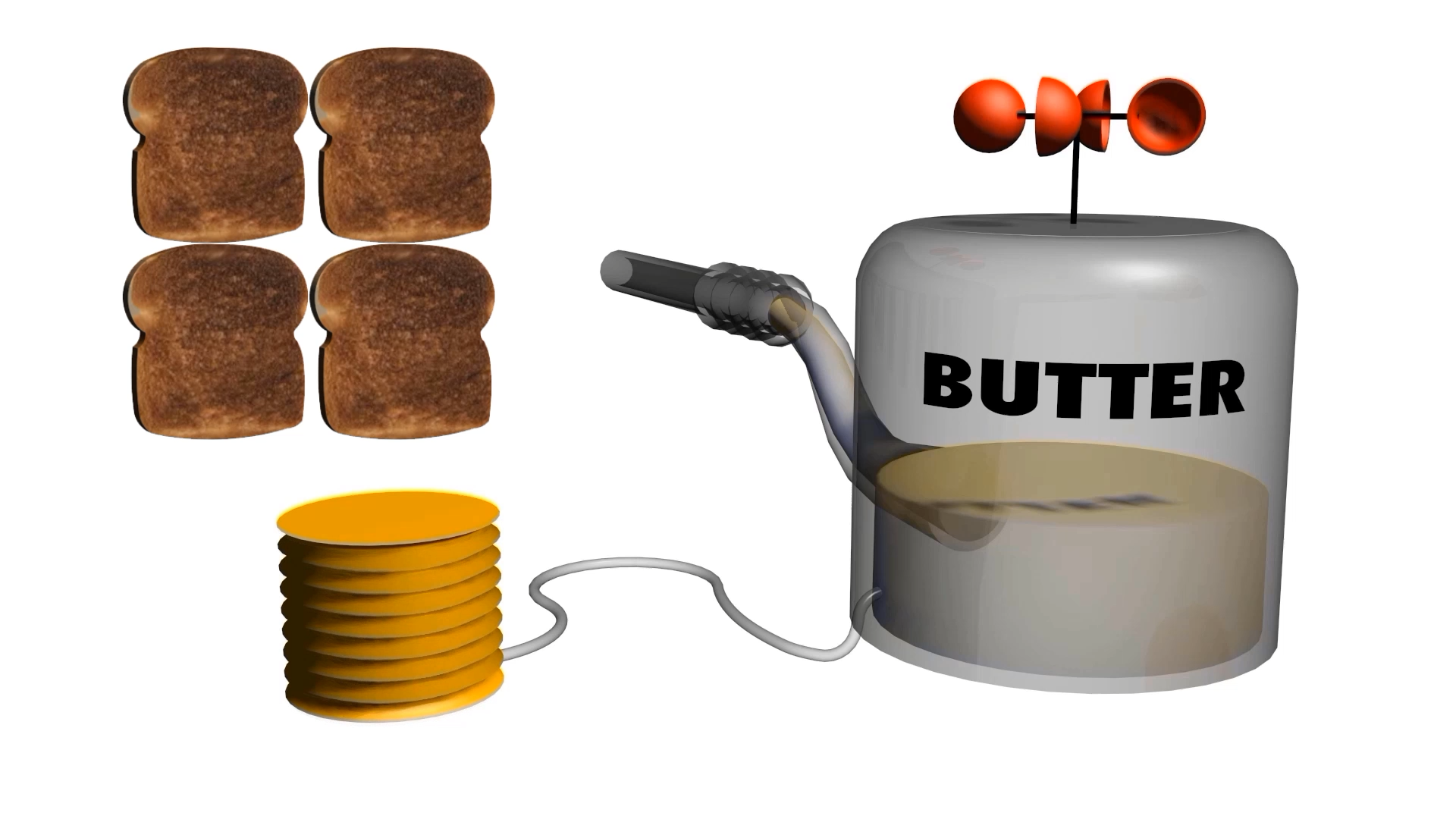
I’m not saying that I do, and I am not saying that I don’t. But hypothetically maybe, suppose that on my kitchen table at home I have a gun that shoots butter.
I have experimented carefully. I have placed one piece of toast on a stand one foot from the barrel of the butter gun. If I smack this bellows, the gun will perfectly coat one piece of toast.
Last week, though, I had company staying over. I needed more toast. So I tried something. I figured out that if I doubled the distance to the toast, that same cone of butter would now evenly coat FOUR pieces of toast.
It turned out, though, that when the company arrived, they brought their family along. I needed even more toast. But that’s okay. It turns out, that if I triple the distance between the gun and the toast, I can now coat NINE pieces of toast.
You see, the total amount of toast that gets coated is the same as the distance squared.
But of course, there’s a catch. Because at three-feet, each piece of toast only gets one-ninth of the total butter sprayed.
The total butter hitting that toast is one over the distance squared. Two feet gives us 2×2, which is 1/4 the butter. Three feet is 3×3, or 1/9 the butter. This is called the Inverse Square Law.
This same principal can be applied to things besides butter. This is true for light coming from a fixture, or from a projector.
It’s not important to do this math on a regular basis, but we aneed to understand this: Projectors and lighting instruments are designed to produce a patch of light up to a given size. When you go much larger than that, the usefulness of the light starts to go down at an exponential rate.
The flip side of this is that if you have light or a projector that are not super-duper bright, you can make them do some pretty impressive things if you find a way to use them so that they aren’t spreading their butter very thin at all.