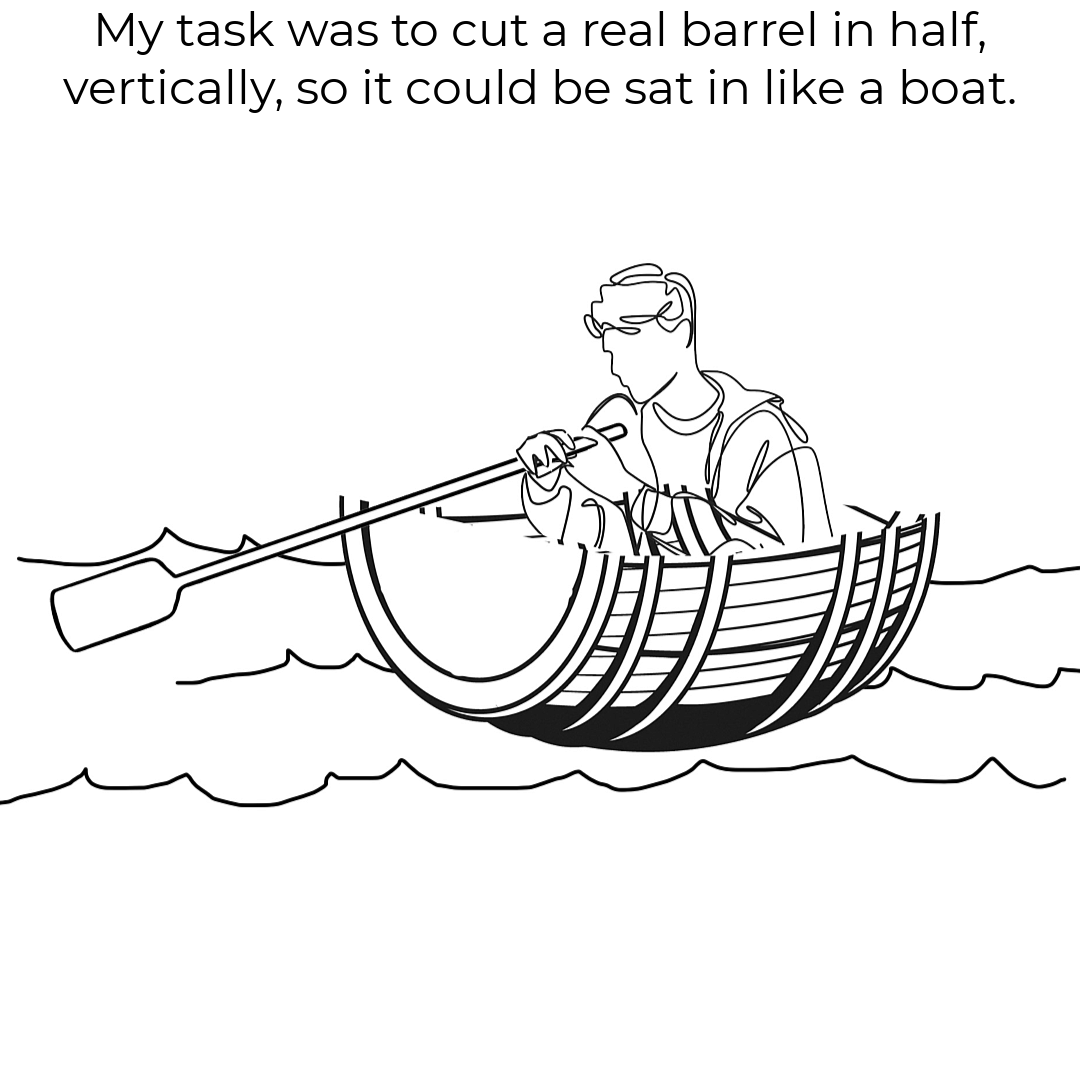
Back in graduate school, maybe 1993, I worked in the scene shop. I was usually in charge of overseeing groups of undergrads and we would work on various tasks for the current shows we were doing, and sometimes I would be given specific special projects. I wasn’t a designer or anything for the show I’m discussing today – I only participated by working on it during the day from the scene shop.
This production was happening in a thrust theatre space. It has a scene in it that happens in a rowboat.
In this particular production, the set design included barrels.
The creative team had decided to make the rowboat happen by using one of the barrels. My task was to cut a real barrel in half, vertically, so it could be sat in like a boat.
If you know about barrels, you know that they are air-tight and water-tight. They have curved vertical pieces of wood called staves. These join together and try to push outward kind of like an archer’s bow. They are held together by metal hoops. You’ll see half-barrels used as planter boxes. If you cut a barrel in half vertically, though, you’re removing the physics that keep it together.
I don’t mind a challenge, though, so I got to work. I cut each hoop and watched it spring off. I cut the ends of barrel in half and replaced them with plywood. I then got new 1½” steel band bent them into half curves. I predrilled each piece of metal where it would line up with a stave. Then I diligently rebuilt the barrel into two halves that could stand together as a single barrel, or they could be set on the deck and sat in like a boat. It took time, but I was very proud of the result.
A day or two later we got a note regarding the barrels: “Put handles on barrels.”
Oh. Okay. Apparently, they are moving the barrels around as boats and they want to be able to lift them more gracefully.
I made four rounded wooden handles. I attached them to what amounted to the gunwale of the boats. This way, when they were laid down, they could also be carried easily.
The next day, we got another note: Move handles lower on boat. That’s all it said. I simply did not understand what that meant. So I left the scene shop, and I went and found – I think the stage manager – for the show and asked about it.
Here is what I learned (paraphrased)(it was a long time ago!):
“We originally asked for the barrels and the boats to be the same thing because we wanted to reduce the workload in the scene shop.”
“We tried to get the actors to sway in the barrels. But the Barrel just sort of went all the way over.”
“So we thought if we added handles to them, that would stop them from rolling.”
“But the handles are too high to prevent that, so we want them moved down lower.”
I knew where this was going. I followed the process, though. I moved the handles down like this. When the actors sat in them barrels, they now rolled like this: CLUNK.
Finally, I was asked to make wooden rockers for the barrel. The looked about like this. I think they put this one in the back so the rocker didn’t usually show.
And this worked.
But. By the time I split a barrel in half, replaced the hoops, reattached all of the staves, made handles, moved the handles, and then made rockers …
We could have built a boat.
And this was intended to make things easier for us.
So please. when you are a part of a creative team, and you are asking for something,
Start with the problem. Not the solution.