This is for a very specific type of nerd: Technology, lighting, theater, and history. This is Conference by Candlelight.
It was a 3-day event in Sweden in June of 2026. It was held in three different 18th century theaters. It was an exploration of theater technology from the 1700s.
Please pardon the quality of my cell phone videos (in the video).
On day one, we began at the residence of the Swedish royal family. Drottningholm Home Court Theater was built in 1766. It has a raked stage and a fully working pole and chariot system. Lots of topics were presented that pertain to the space. Technical director Åsa Tilman discussed machinery in the theater. waves.
In her words (in the video): “The waves are extremely heavy. And directors come and say, ‘I want 20 minutes of waves.’ And Kristian (the producer in the theatre) says, “No way. You can have four because they’re so heavy. You pull them upwards and then you have to hold them going down so they go unevenly.”
This is the pole and chariot system (see Drottningholms Slottsteater backstage 5 min at https://vimeo.com/291460936). The crew was limited this day, so some things were simplified. The waves are a part of a building filled with brilliant machines. Here, I just pointed my phone into the machinery under the deck. There’s lots of machinery down there for other effects. Everything is crafted in forced perspective. Perfectly placed seats are reserved for the king and queen.
Åsa is demonstrating a rain machine in the wings. Me: “And what’s inside that?” Åsa: “Peas.” “It’s what?” “Peas. Peas. And, um, piano thread.”
This is the thunder machine in the attic space over the theater. It’s a wooden seesaw box filled with stone spheres.
Adam Mendelson: “I allowed to?” (Adam operates the machine.) This is a wind machine. It’s canvas riding on a louvered drum. The design persisted into the 20th century. I remember using one of these in the 1980s. Åsa is operating the thunder in accompaniment, with a rope.
In Drottningholm Home, we were limited in where we could go, so I recorded everything I could from the wings. Most of it is very old, but it’s also really familiar.
Drottningholm cannot use candles as light sources. Instead it uses a system of fiber optic cables and small mirrors. Mirrors and fiber optics are placed exactly in candle positions. 21st century control systems emulate candlelight. Here they’re blasting the brightness to show us how it works.
A lot more happened on day one, but let’s keep this moving.
On day 2, we convened at The Palace Theatre Confidencen. It is on the grounds of Ulriksdal Palace on the north side of Stockholm. This is the oldest theater in Sweden, built in 1753.
Here they can use real candles as light. There are rotating sconces behind each wing. Four chandeliers hang from the proscenium for face light. Footlights are placed across the edge of the stage.
The electric stage lights were turned down. It took a while to get all the candles lit.
For this group of artists, this was a huge amount of suspense.
We experimented with stage position and with handheld candles.
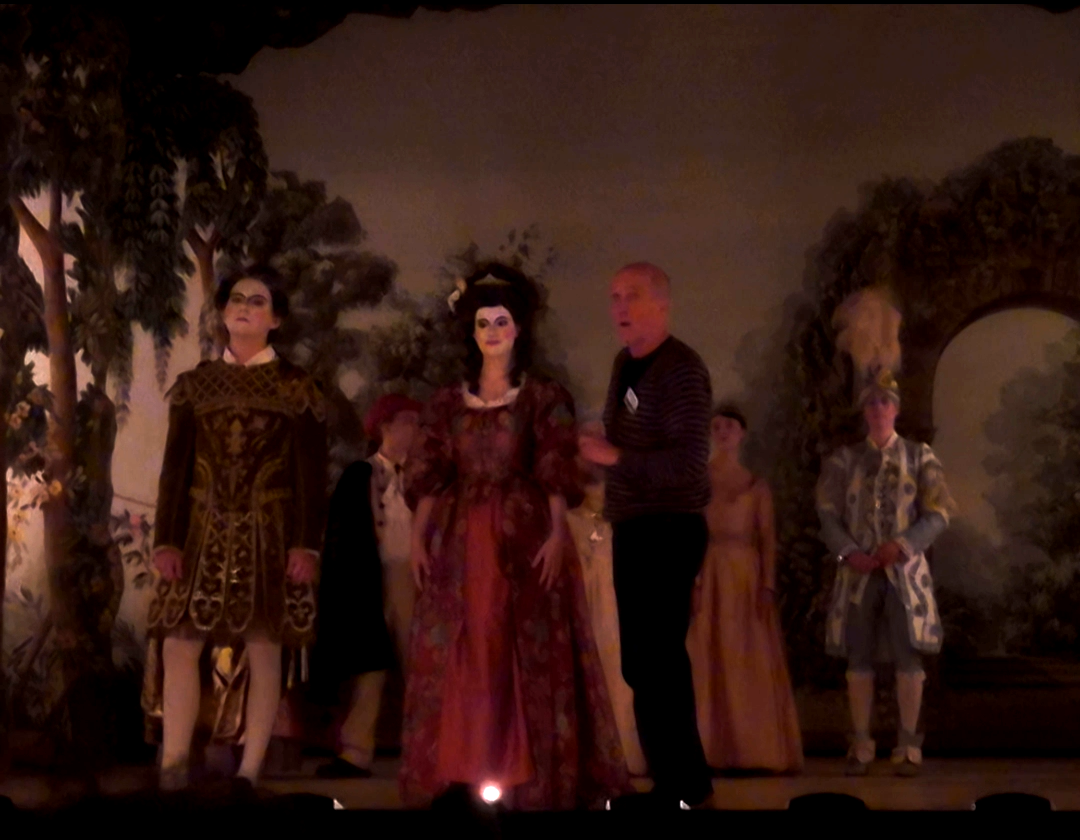
With everything lit, the set was changed to a forest. Student technicians very kindly dressed as actors.
Stage position near the candles is crucial. We examined varying methods of makeup and costumes. We played with different positions of candelabras. Comparisons and lineups like this quickly proved best methods.
The faces of actors without makeup were impossible to read. Costumes with bold contrasts worked best. White makeup with sculpting was easy to see and it was convincing.
This video is much more forgiving than the human eye.
Artificial silhouettes like these wings read well.
We had to negotiate the best ways to capture what we were seeing. The phones in use were producing a lot of light: Michael Ramsaur: “Could we get about 30 seconds with no cameras?”
We then explored the stage in moderate sized groups. We tested the brightness of the candles, each using our own methods.
Here you can see the painted main curtain in the candle light.
On day three, we traveled south of Stockholm to Gripsholm Castle. Gripsholm houses the National Portrait Gallery of Sweden. It’s a huge museum with centuries of content. Unfortunately, for this video, I’m not focusing on this content. It’s beautiful and it goes on and on. This castle includes a perfectly preserved theater. The theatre at Gripsholm has not been renovated. Instead, it has been preserved since its last performance closed in 1785. The four bright hatches you see here were for servants to watch performances through. The painted 2D curtains and scenery here are all original. Note how well the painted columns on stage match the 3D architecture. That low dome center stage is a prompter’s box. It’s accessed from below.
The machinery under the stage has also been preserved. You can hear the centuries old wood creaking as we all walk on it.
The machinery operates the pole and chariot system on the stage above. There’s also a thunder run under the stage. Wooden tracks for round stones.
I have a ton of ideas and information I’ve taken away from this whole experience. I’m going to end this video right here today. though. I know I will incorporate all of this into more content that I make later.
Thank you.
This documents a three-day conference in Sweden in which designers explored theatre technology and lighting from the 1700s in historic theatres in Stockholm. Staging performance in candlelight was a centerpoint along with dicussion of 18th century stage machinery and techniques. #stagecraft #theatrelight #theatre #theatredrama #theatrehistory #stagelighting
Music: “Magic Escape Room” Kevin MacLeod (incompetech.com) Licensed under Creative Commons: By Attribution 4.0 License http://creativecommons.org/licenses/by/4.0/